Kamis, 26 Februari 2009


4 of best tanki in the world


M1 Abrams armament
The main armament is the 120mm M256 smoothbore gun, developed by Rheinmetall Waffe Munition GmbH of Germany. The 120mm gun fires the following ammunition: the M865 TPCSDS-T and M831 TP-T training rounds, the M8300 HEAT-MP-T and the M829 APFSDS-T which includes a depleted uranium penetrator. Textron Systems provides the Cadillac Gage gun turret drive stabilisation system.
The commander has a 12.7mm Browning M2 machine gun and the loader has a 7.62mm M240 machine gun. A 7.62mm M240 machine gun is also mounted coaxially on the right hand side of the main armament.


FV4034 Challenger 2 is a main battle tank (MBT) currently in service with the armies of the United Kingdom and Oman. It is built by the British company Vickers Defence Systems (now part of BAE Systems Land and Armaments). The manufacturer advertises it as the world's most reliable main battle tank[2] As of January 2008, two Challenger 2s have been damaged in combat, and one destroyed by another Challenger 2 in a friendly fire incident.
Challenger 2 is an extensive redesign from Challenger 1, the MBT from which it was developed. It uses the basic hull and automotive parts of its predecessor but all else is new. Less than 5% of components are interchangeable. Challenger 2 has now replaced Challenger 1 in service with the British Army and is also used by the Royal Army of Oman. It has seen operational service in Bosnia, Kosovo and Iraq (2003–present). During the 2003 invasion of Iraq the Challenger 2 was the only tank operating in the Gulf that did not suffer a loss to enemy fire. In one engagement a Challenger took multiple hits from rocket propelled grenades and from one MILAN anti tank missile.[


history


Challenger 2 is the third vehicle of this name, the first being the A30 Challenger, a Second World War design using the Cromwell tank chassis with a 17 pdr gun. The second was the Persian Gulf War era Challenger 1, which was the British army's main battle tank (MBT) from the early 1980s to the mid-1990s.
Vickers Defence Systems (later Alvis Vickers, now BAE Systems Land Systems) began to develop a successor to Challenger 1 as a private venture in 1986. Following the issue of a Staff Requirement for a next-generation tank, Vickers formally submitted its plans for Challenger 2 to the Ministry of Defence (MoD). They were awarded a £90 million contract for a demonstrator vehicle in December 1988. In June 1991, after competition from other tank manufacturers designs (including the M1A2 Abrams, the Leopard 2 (Improved) and the Leclerc), the MoD placed a £520 million order for 127 MBTs and 13 driver training vehicles. An order for a further 259 tanks and 9 driver trainers (worth £800 million) was placed in 1994. Oman ordered 18 Challenger 2s in 1993 and a further 20 tanks in November 1997.
Production began in 1993 at two primary sites: Elswick, Tyne and Wear and Barnbow, Leeds, although over 250 subcontractors were involved. The first tanks were delivered in July 1994.
Challenger 2 successfully completed its Reliability Growth Trial in 1994. Three vehicles were tested for 285 simulated battlefield days. Each day is known to have consisted of:
27 km of On-road Travel
33 km of Off-road Travel
34 Main Armament Rounds fired
1,000 7.62 MG rounds fired
16 h Weapon System Operation
10 h Main Engine Idling
3.5 h Main Engine Running
An equally important milestone was the In-Service Reliability Demonstration (ISRD) in 1999. 12 fully crewed tanks were tested at the Bovington test tracks and at Lulworth Bindon ranges. The tank exceeded all staff requirements.
Challenger 2 entered service with the British Army in 1998 (with the Royal Scots Dragoon Guards in Germany), with the last delivered in 2002. It is expected to remain in service until 2035. It serves with the Royal Scots Dragoon Guards, the Royal Dragoon Guards, the Queen's Royal Hussars, the King's Royal Hussars and the 2nd Royal Tank Regiment, each of which is the tank unit of an armoured or a mechanised brigade. Two squadrons of the 1st Royal Tank Regiment use Challenger 2 in a training / demonstration role.
Deliveries of Challenger 2 to Oman were completed in 2001.
The Trojan minefield breaching vehicle and the Titan bridge-laying vehicle based on aspects of the Challenger 2 were shown in November 2006; 66 are to be supplied by BAE Systems to the Royal Engineers, at a cost of £250M.[4]

Defence
Challenger 2 is one of the most heavily armoured and best protected tanks in the world.[6] The turret and hull are protected with second generation Chobham armour (also known as Dorchester) the details of which are still classified. Explosive Reactive Armour (ERA) kits are also fitted as necessary. The nuclear, biological and chemical (NBC) protection system is located in the turret bustle. On each side of the turret are five L8 smoke grenade dischargers. Challenger 2 can also create smoke by injecting diesel fuel into the exhaust manifolds.

[edit] Drive System
Engine: Perkins 26.1 litre CV12 diesel engine delivering 1,200 hp (895 kW).
Gearbox: David Brown TN54 epicyclical transmission (6 fwd, 2 rev).
Suspension: Second-generation Hydrogas.
Track: William Cook Defence Hydraulically Adjustable double-pin.
Maximum speed: 45 mph, 75 km/h (road) 25 mph, 40 km/h (cross country)
Range: 280 miles, 450 km (road) 156 miles, 250 km (cross country).


Senin, 23 Februari 2009

military vihincle


Variants
Main article: F-16 Fighting Falcon variants

Static display, Farnborough, 2006
F-16 models are denoted by sequential block numbers to denote significant upgrades. The blocks cover both single- and two-seat versions. A variety of software, hardware, systems, weapons carriage, and structural enhancements have been instituted over the years to gradually upgrade the F-16 and retroactively implement the upgrades in previously delivered aircraft.
While many F-16s were produced according to these block designs, there have been many other variants with significant changes, usually due to modification programs. Other changes have resulted in role-specialization, such as the close air support and reconnaissance variants. Several models were also developed to test new technology. The F-16 design also inspired the design of other aircraft, which are considered derivatives.

[edit] Main production variants
Block
Models
Engine
1
F-16A / B
PW F100-PW-200
5
F-16A / B
PW F100-PW-200
10
F-16A / B
PW F100-PW-200
15
F-16A / B
PW F100-PW-200
20
F-16A / B
PW F100-PW-200
25
F-16C / D
PW F100-PW-220E
30
F-16C / D
GE F110-GE-100
32
F-16C / D
PW F100-PW-220E
40
F-16C / D
GE F110-GE-100
42
F-16C / D
PW F100-PW-220E
50
F-16C / D
GE F110-GE-129
52
F-16C / D
PW F100-PW-229
60
F-16E / F
GE F110-GE-132

[edit] F-16A/B
The F-16A (single seat) and F-16B (two seat) were initially equipped with the Westinghouse AN/APG-66 pulse-doppler radar, Pratt & Whitney F100-PW-200 turbofan, rated at 14,670 lbf (64.9 kN) and 23,830 lbf (106.0 kN) with afterburner. The A and B variants include Blocks 1, 5, 10, 15 and 20. The USAF bought 674 F-16As and 121 F-16Bs, with delivery completed in March 1985. The F-16A/B had a unit cost of US$14.6 million (1992).
Early blocks (Block 1/5/10) featured relatively minor differences between each. Most were later upgraded to the Block 10 configuration in the early 1980s. Block 15 aircraft was the first major change in the F-16. It featured larger horizontal stabilizers, the addition of two hardpoints to the chin inlet, an improved AN/APG-66(V)2 radar, and increased capacity for the underwing hardpoints. Block 15 also gained the Have Quick II secure UHF radio. The horizontal stabilizers were enlarged by 30% to counter the additional weight of the new hardpoints. Block 15 is the most numerous variant of the F-16, with 983 produced.

USAF F-16C
Block 20 added some F-16C/D capability: Improved AN/APG-66(V)3 radar, carriage of AGM-45 Shrike, AGM-84 Harpoon, and AGM-88 HARM missiles, as well as the LANTIRN navigation and targeting pod. The Block 20 computers are significantly improved in comparison to that of the earlier versions. The Republic of China (Taiwan) received 150 F-16A/B Block 20 aircraft.[109]

[edit] F-16C/D
F-16C (single seat) and F-16D (two seat) variants were introduced in service in 1984. The Block 25 was the first C/D block. It added all-weather capability with beyond-visual-range (BVR) AIM-7 and AIM-120 air-air missiles.[110] Block 25 introduced a substantial improvement in cockpit avionics, and improved AN/APG-68 radar. Block 25s were first delivered with the Pratt & Whitney F100-PW-200 engine and later upgraded to the Pratt & Whitney F100-PW-220E. A total of 209 Block 25 aircraft were delivered.[111] The F-16C/D had a unit cost of US$18.8 million (1998)[1]

Three U.S. Air Force F-16 Block 30 aircraft fly in formation over South Korea
Block 30/32 was the first block of F-16s affected by the Alternative Fighter Engine project under which aircraft were fitted with the traditional Pratt & Whitney engines or, for the first time, the General Electric F110-GE-100. From this point on, blocks ending in "0" (e.g., Block 30) are powered by GE, and blocks ending in "2" (e.g., Block 32) are fitted with Pratt & Whitney engines. The first Block 30 F-16 entered service in 1987. Major differences include the carriage of the AGM-45 Shrike, AGM-88 HARM, and the AIM-120 missiles. From Block 30D, aircraft were fitted with larger engine air intakes (called a Modular Common Inlet Duct) for the increased-thrust GE engine. A total of 733 Block 30/32 aircraft were produced and delivered to six countries.[112]

An Egyptian Air Force F-16D Block 40
Block 40/42 entered service in 1988. It is the improved all-day/all-weather strike variant equipped with LANTIRN pod; also unofficially designated the F-16CG/DG, the night capability gave rise to the name "Night Falcons". This block features strengthened and lengthened undercarriage for LANTIRN pods, an improved radar, and a GPS receiver. From 2002, the Block 40/42 increased the weapon range available to the aircraft including JDAM, AGM-154 Joint Standoff Weapon (JSOW), Wind-Corrected Munitions Dispenser (WCMD) and the (Enhanced) EGBU-27 Paveway “bunker-buster”. A total of 615 Block 40/42 aircraft were delivered to 5 countries.[113]
Block 50/52 F-16 was first delivered in late 1991; the aircraft are equipped with improved GPS/INS, and the aircraft can carry a further batch of advanced missiles: the AGM-88 HARM missile, JDAM, JSOW and WCMD. Block 50 aircraft are powered by the F110-GE-129 while the Block 52 jets use the F100-PW-229. Block 50/52 Plus (or 50/52+), which is also known as the "Advanced Block 50/52", was first delivered in April 2003 to the Hellenic Air Force. Its main differences are the addition of conformal fuel tanks (CFTs), APG-68(V9) radar, On-Board Oxygen Generation (OBOGS) system and JHMCS helmet.[114]

[edit] F-16E/F
F-16E (single seat) and F-16F (two seat). Originally, the single-seat version of the General Dynamics F-16XL was to have been designated F-16E, with the twin-seat variant designated F-16F. This was sidelined by the Air Force's selection of the competing F-15E Strike Eagle in the Enhanced Tactical Fighter fly-off in 1984. The 'Block 60' designation had also previously been set aside in 1989 for the A-16, but this model was dropped.[115] The F-16E/F designation now belongs to a special version developed especially for the United Arab Emirates, and is sometimes unofficially called the "Desert Falcon".

United Arab Emirates F-16 Block 60 taking off after taxiing out of the Lockheed Martin plant in Fort Worth, TX (NAS Fort Worth JRB)
Block 60 is based on the F-16C/D Block 50/52, it features improved radar and avionics and conformal fuel tanks; it has only been sold to the United Arab Emirates. At one time, this version was incorrectly thought to have been designated "F-16U". A major difference from previous blocks is the Northrop Grumman AN/APG-80 Active Electronically Scanned Array (AESA) radar, which gives the airplane the capability to simultaneously track and destroy ground and air threats. The Block 60's General Electric F110-GE-132 engine is a development of the -129 model and is rated at 32,500 lbf (144 kN). The Block 60 allows the carriage of all Block 50/52-compatible weaponry as well as AIM-132 Advanced Short Range Air-to-Air Missile (ASRAAM) and the AGM-84E Standoff Land Attack Missile (SLAM). The CFTs provide an additional 450 US gallon (2,045 L) of fuel, allowing increased range or time on station and frees up hardpoints for weapons instead of underwing fuel tanks. The MIL-STD-1553 data bus is replaced by MIL-STD-1773 fiber-optic data bus which offers a 1000 times increase in data-handling capability. UAE funded the entire $3 billion Block 60 development costs, and in exchange will receive royalties if any of the Block 60 aircraft are sold to other nations. Press reports state this is "the first time the US has sold a better aircraft overseas than its own forces fly".[116] The F-16E/F has a unit[clarification needed] cost of US$26.9 million (2005).[citation needed]


Operation Enduring Freedom - Afghanistan (OEF-A) by galih prihantoro

[edit] The Taliban
Seizing upon a power vacuum after the Soviets withdrew from Afghanistan after their invasion, the Taliban assumed the role of government from 1996-2001. Their extreme interpretation of Islamic law prompted them to ban music, television, sports, and dancing, and enforce harsh judicial penalties (See Human rights in Afghanistan). Amputation was an accepted form of punishment for stealing[9][10], and public executions could often be seen at the Kabul football stadium.[11][12] Women's rights groups around the world cried often and loudly as the Taliban banned women from appearing in public or holding many jobs outside the home. They drew further criticism when they destroyed the Buddhas of Bamyan, historical statues nearly 1500 years old, because the buddhas were considered idols.
In 1996, Saudi dissident Osama bin Laden moved to Afghanistan upon the invitation of the Northern Alliance leader Abdur Rabb ur Rasool Sayyaf. When the Taliban came to power, bin Laden was able to forge an alliance between the Taliban and his al-Qaeda organization. It is understood that al-Qaeda-trained fighters known as the 055 Brigade were integrated with the Taliban army between 1997 and 2001. It has been suggested that the Taliban and bin Laden had very close connections.[13]

[edit] US-led coalition action
Main article: War in Afghanistan (2001–present)
On September 20, 2001, the U.S. stated that Osama bin Laden was behind the September 11, 2001 attacks, and made a five point ultimatum to the Taliban: [14].
Deliver to the U.S. all of the leaders of al-Qaeda
Release all imprisoned foreign nationals
Close immediately every terrorist training camp
Hand over every terrorist and their supporters to appropriate authorities
Give the United States full access to terrorist training camps for inspection
On September 21, 2001, the Taliban rejected this ultimatum, stating there was no evidence in their possession linking bin Laden to the September 11 attacks [15].
On September 22, 2001 the United Arab Emirates and later Saudi Arabia withdrew their recognition of the Taliban as the legal government of Afghanistan, leaving neighboring Pakistan as the only remaining country with diplomatic ties.
On October 4, 2001, it is believed that the Taliban covertly offered to turn bin Laden over to Pakistan for trial in an international tribunal that operated according to Islamic shar'ia law [16]. Pakistan is believed to have rejected the offer.[citation needed]
On October 7, 2001, the Taliban proposed to try bin Laden in Afghanistan in an Islamic court[17]. This proposition was immediately rejected by the U.S. Shortly afterward, the same day, the United States, supported by a coalition of other countries, initiated military action against the Taliban, bombing Taliban forces and al-Qaeda terrorist training camps[18].
On October 14, 2001, the Taliban proposed to hand bin Laden over to a third country for trial, but only if they were given evidence of bin Laden's involvement in the events of September 11, 2001[19]. The U.S. rejected this proposal and continued with military operations.
The UN Security Council, on January 16, 2002, unanimously established an arms embargo and the freezing of identifiable assets belonging to bin Laden, al-Qaeda, and the remaining Taliban.

[edit] Combat operations start

Air Force Airman 1st Class Kelliea Guthrie and Senior Airman Greg Ellis guard a C-130 Hercules aircraft during cargo operations at Feyzabab Airfield, Afghanistan.

5-country multinational fleet, during "Operation Enduring Freedom" in the Oman Sea. In four descending columns, from left to right: MM Maestrale (F 570), De Grasse (D 612); USS John C. Stennis (CVN 74), Charles De Gaulle (R 91), Surcouf (F 711); USS Port Royal (CG-73), HMS Ocean (L 12), USS John F. Kennedy (CV 67), HNLMS Van Amstel (F 831); and MM Durand de la Penne (D 560).
On Sunday October 7, 2001, American and British forces began an aerial bombing campaign targeting Taliban forces and al-Qaeda.
The Northern Alliance, fighting against a Taliban weakened by U.S. bombing and massive defections, captured Mazari Sharif on November 9. It rapidly gained control of most of northern Afghanistan and took control of Kabul on November 13 after the Taliban unexpectedly fled the city. The Taliban were restricted to a smaller and smaller region, with Kunduz, the last Taliban-held city in the north, captured on November 26. Most of the Taliban fled to Pakistan. The war continued in the south of the country, where the Taliban retreated to Kandahar. After Kandahar fell in December, remnants of the Taliban and al-Qaeda continued to mount resistance. Meanwhile, in November 2001 the US military and its allied forces established their first ground base in Afghanistan to the south west of Kandahar, known as FOB Rhino.
The Battle of Tora Bora, involving US, British and Northern Alliance forces took place in December 2001 to further destroy the Taliban and suspected al-Qaeda in Afghanistan. In early March 2002 the United States military, along with allied Afghan military forces, conducted a large operation to destroy al-Qaeda in an operation code-named Operation Anaconda. The operation was carried out by elements of the United States 10th Mountain Division, 101st Airborne Division, the US special forces groups TF 11, TF Bowie, and TF Dagger, British Royal Marines, the Norwegian Forsvarets Spesialkommando (FSK), Hærens Jegerkommando and Marinejegerkommandoen, Canada's 3rd Battalion Princess Patricia's Canadian Light Infantry, the Afghan National Army, the German KSK, and elements of the Australian Special Air Service Regiment and of the New Zealand Special Air Service.
After managing to evade U.S. forces throughout the summer of 2002, the remnants of the Taliban gradually began to regain their confidence. A Canadian and US led operation (supported by British and Dutch forces), Operation Mountain Thrust was launched in May 2006 to counter renewed Taliban insurgency.
Since January 2006, the NATO International Security Assistance Force undertook combat duties from Operation Enduring Freedom in southern Afghanistan, the NATO force chiefly made up of British, Canadian and Dutch forces (and some smaller contributions from Denmark, Romania and Estonia and air support from Norway as well as air and artillery support from the US) (see the article Coalition combat operations in Afghanistan in 2006). The United States military also conducts military operations separate from NATO as part of Operation Enduring Freedom in other parts of Afghanistan, in areas such as Kandahar, Bagram, and Kabul (including Camp Eggers and Camp Phoenix.)

[edit] International Support
Main article: Operation Enduring Freedom - Afghanistan: Allies
The United States was supported by several nations during Operation Enduring Freedom (OEF) in Afghanistan in 2001-2003 and in subsequent coalition operations directly or indirectly in support of OEF. See the article Afghanistan War order of battle for the current disposition of coalition forces in Afghanistan. For coalition forces involved in NATO combat operations in southern Afghanistan in 2006, see the article Coalition combat operations in Afghanistan in 2006. For coalition forces involved in NATO operations in 2007, see the article Coalition combat operations in Afghanistan in 2007. And the article International Security Assistance Force for coalition forces in Afghanistan as part of ISAF.


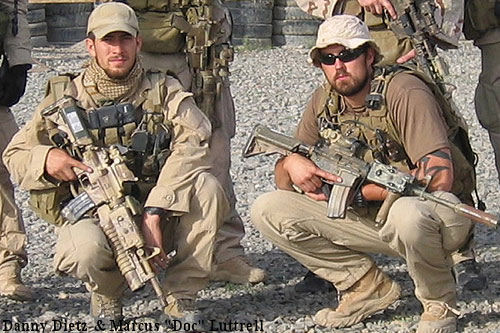
11vuuct0azl__sl110_-lone-suvivor1.jpgdannydietzmarcuslutrell.jpg1874_small-seal-team-10.jpg


S.A.S. scud hunting in IraqBefore the war started, the British Gulf Commander, Lieutenant General Sir Peter de la Billiere, had proposed sending in small teams of Special Air Service (SAS) commandos to harass Iraqi troops in western Iraq, in an effort to distract their attention from the impending main attack into Kuwait.To the surprise of some, this suggestion was approved and two 'Sabre' squadrons (one half of the Regiment's fighting manpower) were deployed and began operations on 20 January 1991. The first SAS troops were inserted into Iraq on 20 January but they were re-tasked within three days to target the mobile Scuds. At first there was no established procedure for the SAS patrols to co-operate with USAF strike aircraft patrolling the Scud boxes. SAS men had to use the emergency "guard" radio frequency to talk to the pilots. Within a short period of time the SAS teams, roving western Iraq in heavily armed truck convoys were almost daily calling down USAF aircraft against suspected Scud launchers. The primary mission for SAS was to locate and designate targets for destruction by Coalition warplanes. To this end, most teams traveled at night, while hiding out during the day. In periods of darkness or for targets obscured by camouflage, the roving teams carried laser target designators (LTD). Using these, an attacking aircraft could employ laser-guided bombs or missiles riding the beam emitted by the LTD. Those targets that were caught out in the open during daylight hours were targeted visually by the operators on the ground who then directed in aircraft armed with unguided bombs and other munitions. The hunters were able to provide information on enemy vehicle movements, however by the time this intelligence was incorporated into the target package oftentimes the mobile launchers had left their hiding place and moved to another location. Beside scud hunting, the troopers also did direct combats. The SAS patrols attacked Iraqi troops with anti-tank missiles and mortars. SAS liaison officers were posted to the joint US/Coalition Tactical Air Control Centre (TACC) in Riyadh and radio procedures established for the ground forces to control air strikes. The TACC was the nerve centre of the Coalition air campaign and had radio links to the AWACS aircraft that co-ordinated all air activity. Coalition aircraft were also warned of SAS patrol areas to prevent 'friendly fire' incidents.One 30-man SAS team, reportedly deployed from Al Jouf, successfully assaulted a Scud command-and-control center, despite the presence of an estimated 300 Iraqi military personnel. One of the more interesting elements of the operation was the group based at the outpostof Al Jouf, approximately 150 miles south of the Iraqi border. This was a truly 'joint' team made up of SAS personnel, along with USAF A-10 Thunderbolt aircraft and AFSOC MH-53J Pave Lows. These British teams soon developed a close relationship with the USAF crews as the Pave Lows provided insertion and the 'Warthogs' were often the first aircraft to respond to reports of TEL sightings. While the SAS was supported by the US elite aviation uniti, it should be mentioned that other SAS units were also transported in their own version of the Chinook, flown by its own helicopter squadron (based in Hereford) or Royal Air Force (RAF) crews. SAS adapted to the harsh terrain by making effective use of light vehicles during their operations instead of patrolling on foot. The SAS drove two versions, the Longline Light Strike Vehicle (LSV) and an updated version of the long-lived "Pink Panther" Land Rover. Both vehicles were designed to carry heavy loads, including two or three fully-equipped soldiers, food, water, ammunition, extra fuel and a wide variety of weapons (up to six Milan or TOW anti-tank missiles, and a mount for a 40mm grenade launcher, 30mm cannon or .50 caliber heavy machine gun). One eight-man SAS team was compromised while on a reconnaissance mission . Four of these troopers died during escape-and-evasion after they were engaged by subsequent Iraqi patrols. Commandos from both groups were injured in firefights with Iraqi forces on a number of occasions in addition to casualties from exposure to unexpectedly cold nighttime weather. The hunt was an unqualified success and may have provided one of the single greatest, and least known, contributions to the victory of Coalition forces in the Gulf.

Minggu, 22 Februari 2009


Navy SEALs" by galih p.


redirects here. For the 1990 film, see Navy SEALs (film).
"Navy seals" redirects here. For military uses of seals and sea lions (the animals), see U.S. Navy Marine Mammal Program.
Navy SEALs
U.S. Navy SEALs Insignia
Active
January 1, 1962–present
Country
United States
Branch
United States Navy
Type
Maritime Special Operations Force
Role
Unconventional Warfare, Direct Action, Counter-Terrorism, Special reconnaissance
Size
~2,500
Part of
United States Naval Special Warfare CommandUnited States Special Operations Command
Garrison/HQ
Coronado, CaliforniaLittle Creek, Virginia
Nickname
Frogmen
Motto
(Unofficial) "Ready to Lead, Ready to Follow, Never Quit""The Only Easy Day Was Yesterday""It Pays to be a Winner"
Engagements
Vietnam WarMultinational Force in LebanonOperation Urgent FuryAchille Lauro hijackingOperation Just CauseOperation Desert StormOperation Restore HopeBattle of Mogadishu (Four operators from the Development Group were a part of the assault convoy)Operation Enduring FreedomOperation Iraqi FreedomOperation Red WingSecond Battle of Ramadi
The United States Navy Sea, Air and Land Forces, commonly known as the Navy SEALs, are the Special Operations Forces of the United States Navy, employed in direct action and special reconnaissance operations. SEALs are also capable of employing unconventional warfare, foreign internal defense, and counter-terrorism missions.
Contents[hide]
1 History
2 Training
2.1 Pipeline
2.1.1 Screening
2.2 Basic Underwater Demolitions/SEAL (BUD/S)
2.3 SEAL Qualification Training (SQT)
2.4 SEAL Platoon Training
3 Navy SEAL teams and structure
3.1 Naval Special Warfare Groups
3.2 SEAL Teams
4 Notable Navy SEALs
5 See also
6 References
7 Further reading
8 External links
//

[edit] History
The Navy Underwater Demolition Teams (UDTs) were a precursor to the current Navy SEALs. The Under-Water Demolition Teams began training in June 1943 at Fort Pierce, Florida in preparation for the D-Day invasion. In World War II, UDT's saw action at Normandy and at various locations in the South Pacific. The UDT's refined and developed their Commando tactics during the Korean War, with their efforts initially focused on demolitions and mine disposal.

Underwater Demolition Team jumps over the side from boat.
President John F. Kennedy, aware of the situations in Southeast Asia, recognized the need for unconventional warfare and special operations as a measure against guerrilla warfare. In a speech to Congress on May 25 1961, Kennedy spoke of his deep respect for the United States Army Special Forces (Green Berets). He announced the government's plan to put a man on the moon, and, in the same speech, allocated over $100 million toward the strengthening of the special operations forces in order to expand the strength of the American conventional forces.
Realizing the administration's favor of the Green Berets, the Navy needed to determine its role within the special operations arena. In March 1961, the Chief of Naval Operations recommended the establishment of guerrilla and counter-guerrilla units. These units would be able to operate from sea, air or land. This was the beginning of the official Navy SEALs. Many SEAL members came from the Navy's UDT units, who had already gained experience in commando warfare in Korea; however, the UDTs were still necessary to the Navy's amphibious force.
The first two teams were on both US coasts: Team One at Naval Amphibious Base Coronado, California and Team Two at Naval Amphibious Base Little Creek, Virginia. The men of the newly formed SEAL Teams were educated in such unconventional areas as hand-to-hand combat, high-altitude parachuting, safe-cracking, demolition, and languages. Among the varied tools and weapons required by the teams was the AR-15 assault rifle, a new design that evolved into today's M16. The SEALs attended UDT Replacement training and they spent some time training in UDTs. Upon making it to a SEAL team, they would undergo a three-month SEAL Basic Indoctrination (SBI) training class at Camp Kerry in the Cuyamaca Mountains. After SBI training class, they would enter a platoon and train in platoon tactics (especially for the conflict in Vietnam).
The Pacific Command recognized Vietnam as a potential hot spot for conventional forces. At the beginning of 1962, the UDT started hydrographic surveys and Military Assistance Command Vietnam (MACV) was formed. In March 1962, SEALs were deployed to South Vietnam for the purpose of training Army of the Republic of Vietnam commandos in the same methods they were trained themselves.
The Central Intelligence Agency began SEAL covert operations in early 1963. At the outset of the war, operations consisted of ambushing supply movements and locating and capturing North Vietnamese officers. Due to poor intelligence information, these operations were not very successful. When the SEALs were given the resources to develop their own intelligence, the information became much more timely and reliable.[citation needed] The SEALs and Special Operations in general started showing an immense success rate, earning their members a great number of citations.[citation needed]
The SEALs were initially deployed in and around Da Nang, training the South Vietnamese in combat diving, demolitions, and guerrilla/anti-guerrilla tactics. As the war continued, the SEALs found themselves positioned in the Rung Sat Special Zone where they were to disrupt the enemy supply and troop movements and in the Mekong Delta to fulfill riverine (fighting on the inland waterways) operations.
Combat with the Viet Cong was direct. Unlike the conventional warfare methods of firing artillery into a coordinate location, the SEALs operated within inches of their targets. Into the late 1960s, the SEALs were successful in a new style of warfare, effective in anti-guerrilla and guerrilla actions. The Viet Cong referred to them as "the men with green faces," due to the camouflage face paint the SEALs wore during combat missions.
SEALs continued to make forays into North Vietnam and Laos, and unofficially into Cambodia, controlled by the Studies and Observations Group. The SEALs from Team Two started a unique deployment of SEAL team members working alone with South Vietnamese Commandos (ARVN). In 1967, a SEAL unit named Detachment Bravo (Det Bravo) was formed to operate these mixed US and ARVN units, which were called South Vietnamese Provincial Reconnaissance Units (PRU).

At the beginning of 1968, the North Vietnamese and the Viet Cong orchestrated a major offensive against South Vietnam: the "Tet Offensive." The North hoped it would prove to be America's Dien Bien Phu, attempting to break the American public's desire to continue the war. As propaganda, the Tet Offensive was successful in adding to the American protest of the Vietnam war. However, North Vietnam suffered tremendous casualties, and from a purely military standpoint, the Tet Offensive was a major disaster for the Communists.
By 1970, President Richard Nixon initiated a Plan of Vietnamization, which would remove the US from the Vietnam conflict and return the responsibility of defense back to the South Vietnamese. Conventional forces were being withdrawn; however, SEAL operations continued.
On 6 June 1972, Lt. Melvin S. Dry was killed entering the water after jumping from a helicopter at least 35 feet above the surface. Part of an aborted SDV operation to retrieve prisoners of war, Lt. Dry was the last Navy SEAL killed in the Vietnam conflict.[


The USS Carl Vinson (CVN-70) is a United States Navy Nimitz class supercarrier named after Carl Vinson, a Congressman from Georgia.
She was commissioned in 1982 and carries F/A-18 Hornets and F/A-18E/F Super Hornets as well as surveillance and other aircraft. Carl Vinson can carry 85 planes and 5,500 personnel. Traditionally, few ships of the United States Navy were named after a person who was alive at the time of the christening, but recently the number has increased; the list includes Carl Vinson, Hyman G. Rickover, Arleigh Burke, John C. Stennis, Bob Hope, Ronald Reagan, Nitze, Jimmy Carter, and George H. W

Name:
USS Carl Vinson
Namesake:
Carl Vinson
Ordered:
5 April 1974
Laid down:
11 October 1975
Launched:
15 March 1980
Commissioned:
13 March 1982
Homeport:
NS Norfolk, Virginia
Motto:
Vis Per Mare(Strength from the Sea)
Nickname:
Starship Vinson,The Gold Eagle,San Francisco's Own,America's Favorite Carrier,Chuckie V,U.S.S. Chuck Wagon,The Carl Prison,Cell Block 70[citation needed]
Fate:
Active in service as of 2009[update]
Badge:

General characteristics
Class and type:
Nimitz-class aircraft carrier
Displacement:
Approximately 97,000 short tons (88,000 t) full load
Length:
Overall: 1,092 feet (332.8 m)Waterline: 1,040 feet (317.0 m)
Beam:
Overall: 252 ft (76.8 m)Waterline: 134 ft (40.8 m)
Draft:
Maximum navigational: 37 feet (11.3 m)Limit: 41 feet (12.5 m)
Propulsion:
2 × Westinghouse A4W nuclear reactors4 × steam turbines4 × shafts260,000 shp (194 MW)
Speed:
30+ knots (56+ km/h; 35+ mph)
Range:
Essentially unlimited
Complement:
Ship's company: 3,200Air wing: 2,480
Sensors andprocessing systems:
AN/SPS-48E 3-D air search radarAN/SPS-49(V)5 2-D air search radarAN/SPQ-9B target acquisition radar2 × AN/SPN-46 air traffic control radarsAN/SPN-43B air traffic control radarAN/SPN-44 landing aid radars4 × Mk 91 NSSM guidance systems4 × Mk 95 radars
Electronic warfareand decoys:
SLQ-32A(V)4 Countermeasures suiteSLQ-25A Nixie torpedo countermeasures
Armament:
2 × Mk 57 Mod3 Sea Sparrow2 × RIM-116 Rolling Airframe Missile3 × Phalanx CIWS
Armor:
Unknown
Aircraft carried:
90 fixed wing and helicopters
prestasi kawasaki athlete 125 di indoprix
Kawasaki Athlete 125 yang digeber Hadi Wijaya mengejutkan panggung seri pembuka IndoPrix 1 Sentul kelas 125 cc (IP2), Minggu lalu. Otak dibalik tim Kawasaki Elf IRC NHK Rextor M-Tech itu adalah Jeremy Burgess, mekanik Valentino Rossi. He…he…he… tapi yang ini versi Indonesia, yaitu Ibnu Sambodo.

Ibnu yang Begawan 4-tak itu ibarat Jeremy Burgess, mengorek motor merek apapun bikin pembalapnya menang. Seperti Hadi Wijaya sanggup finish ke-2 di race pertama. Itupun karena per sok Daytona patah. Jika normal pasti yang pertama. Pada race 2, satu lap menjelang finish mesin trouble.

Langkah awal Jeremy Burgess dan Ibnu sama. Serba mefet dan terburu-buru. Persiapannya hanya 2 minggu. Setelah belah dan korek mesin, Athlete 125 geberan Hadi baru hidup Selasa 7 Maret lalu. “Berarti 4 hari sebelum balap,” jelas Ibnu Sambodo.

Paling awal dijamah Ibnu menentukan ukuran piston buat turun di kelas IP2. Untuk tes dan latihan menggunakan seher Daytona 56 mm (125 cc). “Baru hari Minggu pas balapan menggunakan seher Izumi 57 mm (130 cc),” jelas jebolan sarjana elektro ini.

Kemudian kepala silinder menyusul diporting. Klep ditentukan ukuran 29 mm in dan ex 24 mm. Menurut Ibnu, pilihannya menggunakan klep merek EE atau milik Suzuki DR350. Ibnu pilih yang punya DR350, kebetulan punya 20 set bekas dari tim Suzuki dulu.1700kawak-bela-3.jpg

Tentu ketika pasang klep lebar mengubah dulu posisi sudut klep di kepala silinder. Diikuti korek lubang isap dipatok 25,5 mm. Kecuali pada bagian bos klep, lubang membesar ke kiri-kanan jadi 30 mm. Ini agar laju gas bakar tidak tersendat akibat terhalang bos klep.

Sedang lubang buang mengikuti katup ex yang 24 mm. “Lubang buangnya cukup 23,5 mm. Diteruskan menuju leher knalpot yang diameter dalam pipanya 24 mm,” jelas Ibnu yang buka bengkel Manual Tech di Jl. Kaliurang, Km 8,4, Jogja.

Beres korek yang dites duluan Kawasaki Athlete Ardhi Satya Sadarma, rekan satu tim Hadi Wijaya. “Sanggup menghasilkan tenaga 20,1 dk pada 12.600 rpm. Pada pacuan Hadi sendiri justru sekitar 19 dk,” jelas mekanik yang juga sarjana mesin ini.

Menurut Hadi, tenaga motor pacuannya ini lumayan besar dibanding lawan. Bahkan performa stabil. Dilihat pada thermometer yang dipasang, suhu blok mesin pada race pertama 160o celcius. Pada race kedua 150 cc, makanya geber abis. Tapi piston tak mendukung dan jebol sebelum finish di race 2. Sayang sekali.

SETING SUSPENSI

1699kawak-bela-2.jpgMenggunakan motor baru, masih serba meraba. Ibnu dibantu Trembis sang asisten seting suspensi. Katanya sok belakang standar sangat empuk. Pada tes awal ketika pindah gigi, motor seperti ngerem. Pusing juga untuk dianalisis. Coba tebak kenapa?

Dipikir seharian, rupanya bila mesin digas bikin sok belakang ambles. Akibatnya lengan ayun menyentuh tuas rem dan bikin roda terkunci. Solusinya coba pasang monosok kepunyaan Yamaha V-ixion merek Daytona.

Namun kendala ngerem sendiri kembali terjadi. Pada race pertama menjelang finish, per monosok Daytona patah. Akhirnya sok ambles dan lengan ayun kembali menekan tuas rem. Dengan melompat-lompat akibat roda belakang terkunci, Hadi masih bisa finish posisi nomor 2. Sangat bagus untuk kondisi begini.

Sedang suspensi depan seperti tidak ada masalah. Asli pabrik diameter as sok 31 mm. Ini setara dengan kepunyaan Yamaha RX-King. Bandingkan punya bebek yang hanya 26 mm. Makanya Trembis hanya mengganti oli sok dengan yang lebih kental. Pakai SAE30 sudah keras.

GIGI MASIH LOMPAT
1701kawak-bela-4.jpg
Beruntung gigi primer (22) dan sekunder (72) Kawak Athlete 125 sama dengan Shogun 125 yang pernah dikorek Ibnu. Perbandingan rasio giginya bisa dibuat mirip atau bahkan sama. Gigi 1 (31/14), 2 (29/18), 3(26/20) dan 4 (25/22).

Namun kendalanya masih kerap mis terutama dari gigi 2 ke 3. Bahkan gigi 4 kerap lompat sendiri ke 3. Pantas saja dilihat dari layar tipi, kaki Hadi kerap nahan persneling. Itu supaya tidak lompat.

WHEELBASE MOLOR

Salut dan tepuk tangan buat Hadi Wijaya yang bisa menaklukan Athlete 125. Nyemplak bebek monosok dipastikan sumbu roda lebih panjang. “Jika diukur dengan patokan yang sama, wheelbase bebek ayam jago Kawasaki ini lebih molor 6 cm dibanding Yamaha atau Suzuki,” tutur Ibnu.

Pantas saja menurut Hadi, terasa berat kalau menikung. Seperti ketika melewati tikungan S kecil. Apalagi bodi Athlete 125 yang tanpa sayap, jauh dari faktor aerodinamis. Jika dilengkapi fairing, pasti jauh meninggalkan lawan.

DATA MODIFIKASI

Karburator : FCR 28
Pilot dan main-jet : 80/150
Gir : 15/37
Intake : Custom
Rasio kompresi 1 : Seher 56 mm yaitu 11,7 : 1
Rasio kompresi 2 : Seher 57 mm yaitu 13,8 : 1
CDI : Rextor Pro Drag
Bearing kruk as : 6205
Kruk asnya : Big end dilas listrik
Manual Tech : (0274) 885566

Minggu, 01 Februari 2009

search military with my "galih prihantoro"

nama saya galih prihantoro.sekolah saya di smp 1 karangmojo, kelas 9a.17-11-1993
disini saya akan mengajak anda untuk mengenal dunia militer di seluruh dunia dari timur tengah seperti afganistan, iraq,israel. eropa seperti italia, france,united kingdom dan usa.anda juga melihat video tni brief.us seal,operation desert stom,dan history topic.ada juga images "AIRCRAFT,SHIP AND NAVY, SOLDIER AND RIFLE, HELICOPTER


buat selingan saya buat posting ini


udah direncanakan sejak lama ...mungkin sejak gw belum dilahirkan dulu .. (halah ...)biarpun stnk & plat nomer blon muncul, si bebek udah melakukanmodifikasi di kawasaki athlete 125 warna ijo ...ijo ..?? jadi inget "The Green Goblin" si musuhnya Spiderman(halah .. si mugi yg kasih julukan cengengesan jumawa di belakang gw ...)(bangga banget kayaknya dia berhasil kasih julukan ... kasih dah ....)here we goes...1. Mindahin injekan kaki rem cakram belakang ke tangan kiribeli master rem setang kiri Rp. 200rbselang rem yang panjang dari setang ke cakram belakang Rp.85rb(sial .. kena palak nih ..padahal waktu beli buat si shogun master cuma Rp.60rb)trus dipasang deh ... nih hasilnya :

foto nya menyusul yah ...
ini beberapa cerita tentang pengalaman si bebek mengendari Kawasaki Athlete 125 yang udah dimodifikasi,dan saat ini odometer sudah menunjukan angka 630km lebih
1. diparkiran dimana aja, banyak sekali orang-orang dan temen-temen yg bertanya tentang specifikasi si Green Goblin ... mungkin emang karena Athlete blon banyak beredar di jalanan bekasi tambun cibitung ..
termasuk juga beberapa mekanik kawasaki saat gw service pertama, tapi mereka lebih tertarik pada modifikasi yg gw lakukan di Athlete.. sampai2 mereka gantian nyobain ntuh motor buat ngerasain hasil modifkasi gw..komentar si mekanik : manteb juga rem blakangnya, beli masternya dimana ..?? eh, mindahin giginya ternyata ga keras yah ...temen2 bilang : wah .. bagasi & tank nya gede juga yah ... 14,3 juta ? mendingan beli ini deh dari pada bebek 125 yg lain ...ada yg bilang : setangnya bikin pegel ... (bebek said : blon biasa aja kali ... kan lw biasa bawa bebek.. yg ini kan stang sport ...)
2. saat service pertama dapet jatah oli + filter oli..
tapi kok dapetnya oli Mesran ..?? karena males berdebat, gw putuskan untuk tambahin duit Rp. 18 ribu biar dapet oli Kawasaki 4T 10-40 Jaso MA & API SL
3. saat riding alone (bobot 65km), cukup mudah mencapai 95kmpj dengan gigi 3 sampai rmp menjerit. Masalahnya blon ketemu jalan yg aman untuk mengetahui top speed di gigi 4.
sempet dapet 110kmpj padahal rpm blon teriak, itu pun dapat dicapai dengan mudah tanpa menunggu lama.
feeling gw, mungkin bisa dapet 125kmpj atau 130kmpj dengan trak agak panjang ...
4. saat riding berboncengan (65kg + 52kg), motor tetap stabil di kecepatan 110kmpj. sempet gw ajak sedikit rebahan di tikungan ke arah pemda cikarang, ga ada gejala ban belakang bergerak liar atau memantul-mantul ..
padahal gw udah khawatir bakal goyang karena shok breker belakang dalam posisi stelan paling randah (lembut) ..
top speed saat berboncengan mungkin dapet 120kmpj kalo aja ada track agak panjang dan aman
so, menurut gw engine performance nya sip banget .. lebih dari yg gw duga ternyata .. jadi benar yg dikatakan om tovi (maestro bz) bahwa Athlete akan galak diputaran bawah karna strokenya yg lebih pendek dari bebek lain sekelasnya .. (thanks ya om tovi.. u are the best ...)
5. saat berboncengan dengan kecepatan 70kmpj, sempet rem mendadak karena ada lubang dalem.
saat itu tangan kanan lagi ngelap spion, jadi jari lagi ga siap di handle rem. tinggal tersisa 1 jari tengah tangan kiri di handle rem kiri (of course..).. trus gw rem deh sebisanya ...
u know what happend ?? rem belakang bekerja dengan baik .. bahkan sedikit nge-lock .. padahal aspalnya bersih dari debu / pasir... padahal gw lg boncengan loh ... ternyata 1 jari udah cukup buat bikin ban belakang nge-lock walau lagi boncengan ..
dan Athlete pun sukses melewati lubang dalem dengan lembut ( tapi ban belakang sempet nyenggol spat board dikit karena mentok saat melewati lubang ..)
6. setelah service pertama, mesin agak ngegelitik kalo diajak narik ... apa setelan klepnya yah ..?? atau emang disengaja klepnya disetel kendor yah ... ? padahal sebelumnya ga bunyi ... mo balik ke beres lagi males nih ...oke itu dulu ..ntar kalo ada cerita lain, ya gw cerita lagi deh ... (emang ada yg baca ... ??? tau deh .. orang cuma pengen nulis doang ....)